The problem
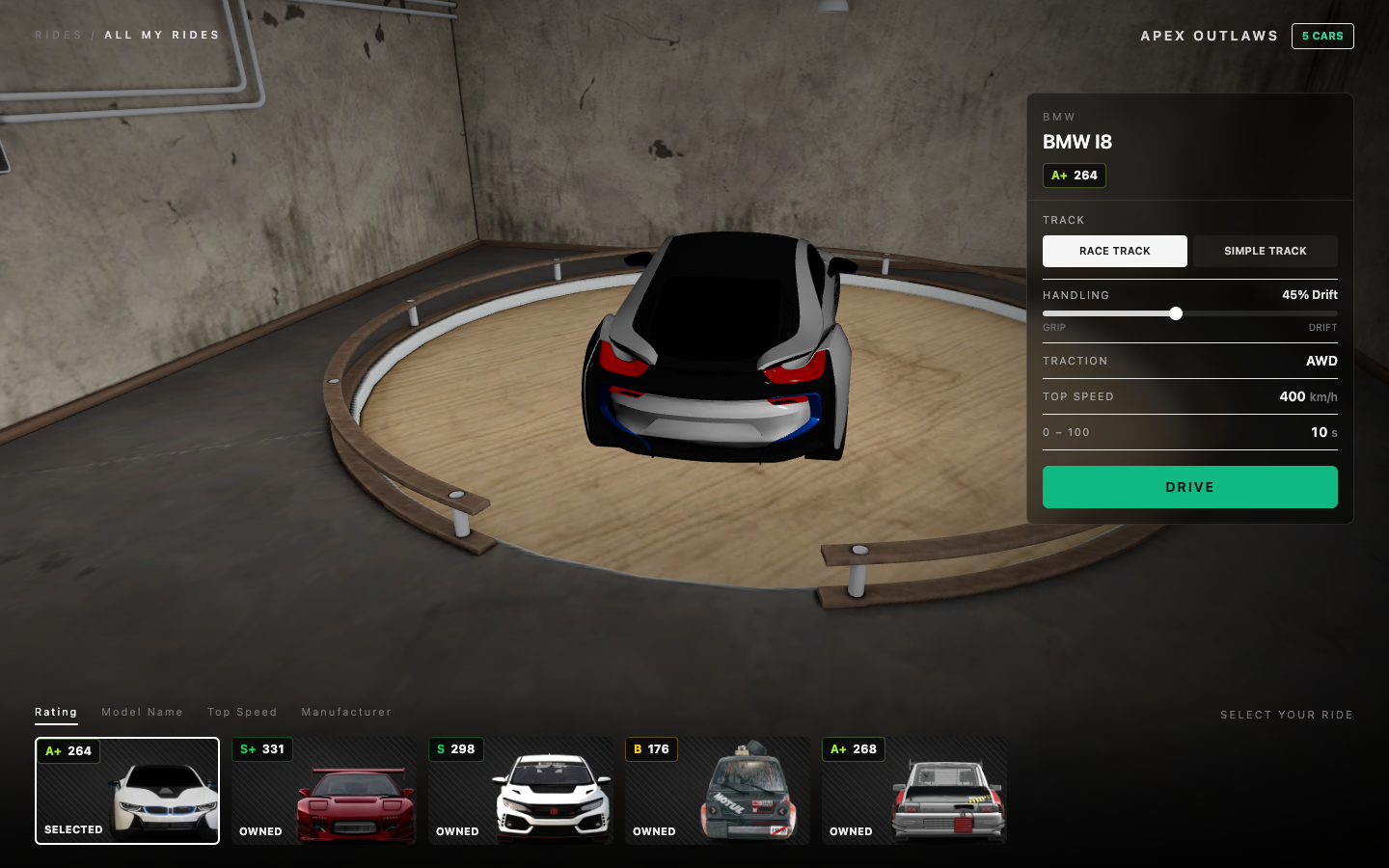
I wanted a racing game I'd actually want to play, without an install. That means two hard things in a browser at once: it has to look like a game, with real car models, a proper garage and a track, and it has to feel like a car — weight, grip, drift — while running at 60 fps next to React.
Most browser driving demos pick one. They're either pretty scenes where the car slides around like a cursor, or physics toys made of boxes.
How it works
  Garage (React UI)  ──pick car + track──▶  Drive scene (R3F <Canvas>)
                                              ├─ Track  (GLB or procedural ring)
                                              ├─ Car    (GLB, auto-scaled)
                                              │    └─ useCarPhysics()  ← input: keyboard / touch / AI
                                              │         └─ telemetry ref ──▶ camera · HUD · engine audio
                                              └─ Multi-camera rig (follow / top / cockpit …)
The whole 3D layer is loaded client-side only (ssr: false) — Three.js can't render on the server, and the garage UI shouldn't wait for it.
Decisions that mattered
What broke — and the rewrite
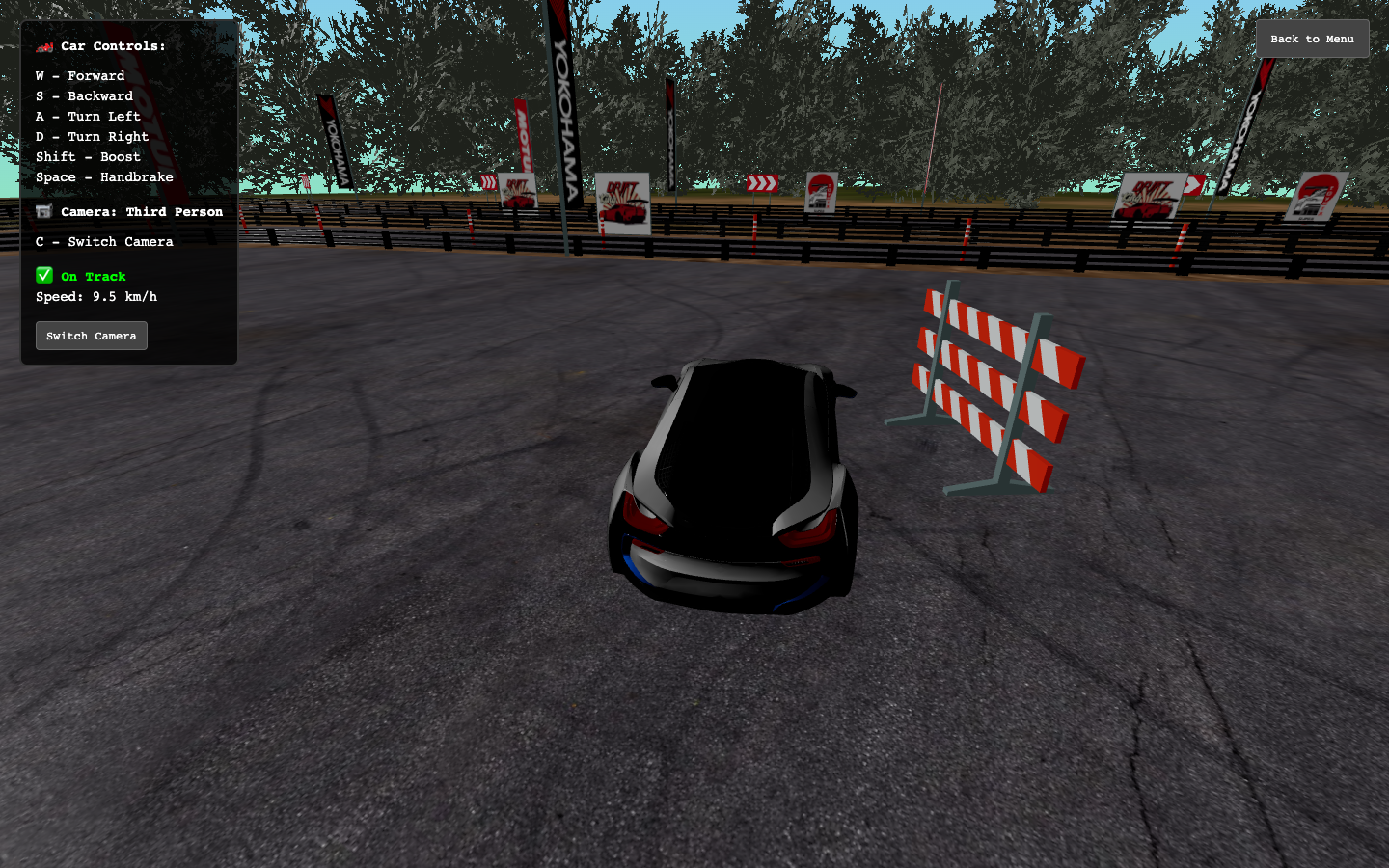
Driving it honestly, the arcade model had real limits. I wrote them down before touching code:
- Suspension was cosmetic — pitch and roll were springs chasing targets, not wheels touching anything.
- Velocity was a single number plus a heading, so the car couldn't slide sideways. No real drift, no sideways shove from a crash.
- Collisions were bounding spheres. Fence rails had spheres 85–184 units wide, so they were excluded — and the car drove straight through the fence.
- The ground raycast didn't actually run every frame, so hills and off-track detection were quietly wrong.
Tech stack
- Next.js + React 19 for the app shell and garage UI
- React Three Fiber + drei for the scene, cameras and GLB loading
- Rapier (rigid body + raycast vehicle) for physics — the live build still runs the earlier arcade model
- Zustand for the one piece of global state (the chosen car), persisted career progress
- Web Audio API for procedural engine, tyre and impact sounds
- glTF-Transform to optimise downloaded models in the browser
What's next
A career mode is already structured — a ladder of fifteen rivals with story cards before and after each race — but the race loop itself is still a stub. Next up: tyre grip that scales with load (so weight transfer changes handling), a debug overlay to prove the physics rules hold, then time-trial ghosts and AI rivals on the same physics interface.